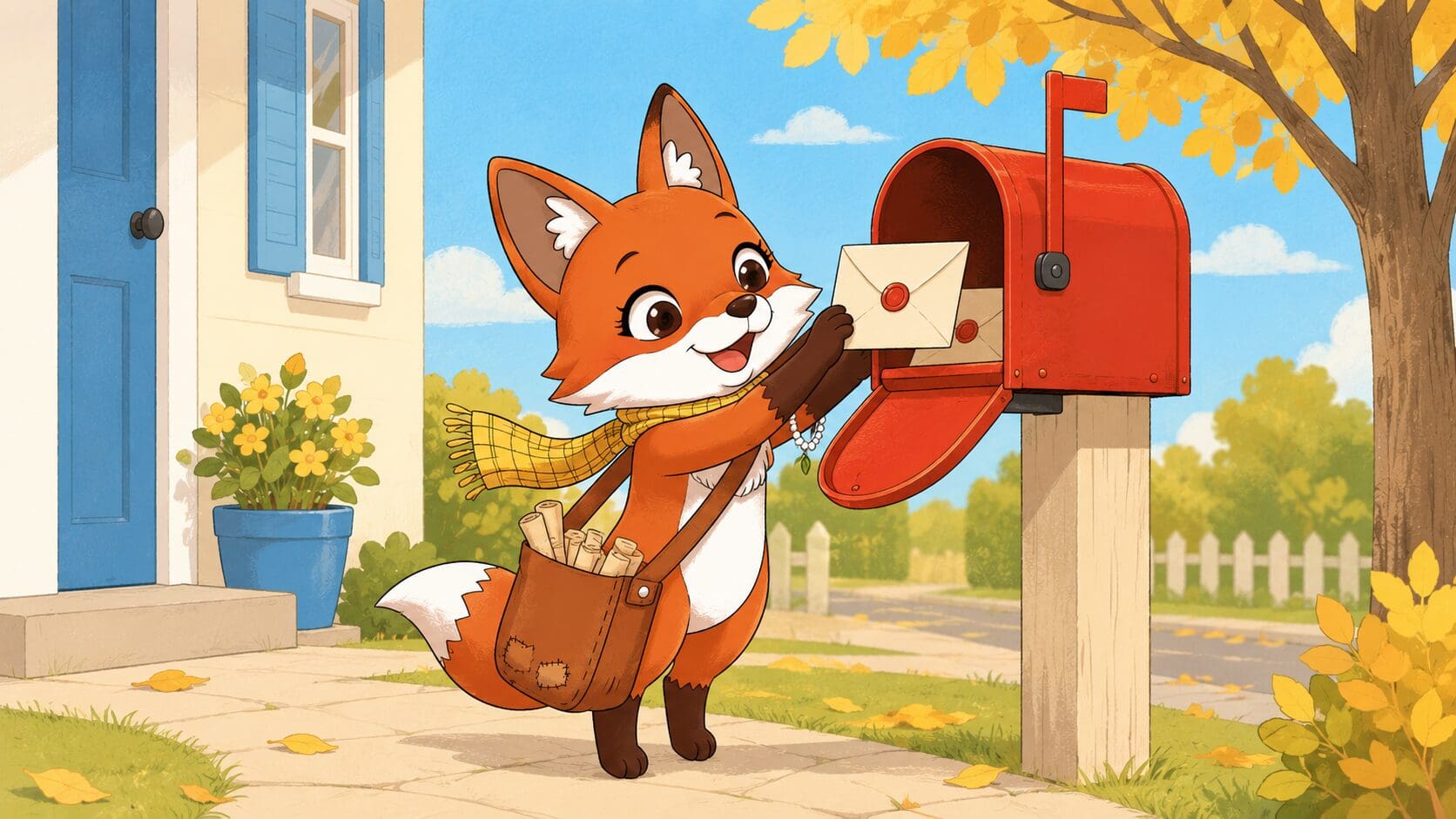
You know the feeling.
You open the mailbox expecting bills and there’s an envelope with your name on it in someone’s actual handwriting. And something happens in your chest before you’ve even opened it.
That’s not nostalgia. That’s your brain doing something it almost never gets to do anymore.
Here’s what’s actually going on — and why it matters more for your kid than it ever did for you.
Your brain treats physical mail differently. On purpose.
Digital notifications are designed to get your attention. They’re engineered to feel urgent, to interrupt, to pull you in. And they work — for about three seconds before the next one arrives.
Physical mail operates on a completely different system.
When something arrives in your mailbox that’s personal — addressed to you, handled by someone who chose to send it — your brain flags it as significant before you’ve even read a word. It’s tangible. You can hold it. It has weight and texture and smell. It traveled to get to you. Someone’s hands touched it.
Your brain knows the difference between a push notification and a letter. It treats them completely differently and it should.
Neuroscientists call this the “haptic advantage” — the cognitive and emotional boost that comes from processing information through touch. Research from the UK’s Royal Mail and Bangor University found that physical material is more “real” to the brain than digital content, triggers more emotional processing, and is better retained in memory. The brain quite literally takes it more seriously.
This is not sentiment. This is neuroscience.
The anticipation is doing real work.
Here’s the part that gets overlooked entirely: the waiting.
The period between knowing a letter is coming and actually receiving it activates the brain’s reward system in a sustained way that instant communication simply cannot replicate. You’re not getting a hit of dopamine and moving on. You’re in an extended state of positive anticipation — checking the mailbox, wondering what it says, carrying the expectation around with you.
That sustained anticipation is genuinely good for the brain. It’s associated with patience, with the ability to tolerate delayed gratification, with hope that isn’t contingent on immediate payoff.
For kids especially — whose brains are being actively shaped right now by the experiences they’re having — repeated practice with meaningful anticipation builds something that’s getting harder and harder to build: the ability to want something and wait for it without falling apart.
A letter in the mail gives kids that practice every single time.
Handwriting does something typing doesn’t.
Reading handwriting is cognitively different from reading a screen. Your brain works slightly harder to process it — and that friction is a feature, not a bug.
That extra cognitive effort is associated with deeper engagement, better retention, and stronger emotional connection to the content. You read a handwritten letter more slowly. You pay more attention. You remember more of what it said.
This is why a handwritten note from someone you love hits differently than a text that says the same words. It’s not that the words are better. It’s that your brain is more present when it’s reading them.
For kids receiving letters from a peer — someone their age who chose to write to them — that effect is amplified. The handwriting is evidence. It proves that a real kid sat down and thought about them and put something on paper specifically for them. No algorithm. No auto-fill. Just a kid and a pen and something they wanted to say.
It creates a different kind of memory.
Ask someone about a text they received two weeks ago. Then ask them about a letter they received as a child.
The letter wins every time.
Physical, personal, rare, effortful — those four qualities tell the brain that something is worth encoding properly. Worth keeping. Worth retrieving later.
The memories your kid is making right now are being stored differently depending on how they’re made. A letter from a pen pal — opened at the kitchen table, read out loud, kept in a box — gets stored differently than a message on a screen. It goes into the part of memory that holds the things that actually mattered.
That’s what you’re giving your kid when you give them real mail. Not just a fun activity. A memory their brain decided was worth keeping.
Why this matters more now than it ever did.
When you were a kid getting real mail was unremarkable. Letters were just how people communicated across distance. The experience was normal.
Your kid is growing up in a completely different world. Real mail is rare for them. Which means when it arrives it carries even more weight — more novelty, more significance, more of that brain-flagging response that makes it memorable.
The rarity is actually working in your favor.
A generation of kids who almost never get personal mail in their mailbox will remember every piece they do get. The bar for impact is low because the baseline is so sparse.
Your kid getting a letter from a pen pal in another state is not a normal Tuesday for them. It’s an event. Their brain knows it. Their body knows it. That’s why they run to the mailbox and carry the envelope inside without putting it down and want you to read it to them immediately.
That response isn’t trained. It’s not performed. It’s just what happens when a brain that’s been optimized for digital input suddenly encounters something genuinely personal and physical and real.
The nostalgia part.
Yes, there’s nostalgia involved when adults respond to real mail. Of course there is.
But nostalgia is not the mechanism. It’s a side effect. The reason real mail hits different is not because you remember getting letters as a kid — it’s because your brain is wired to respond to physical, personal, effortful communication in a way it cannot respond to digital messages, regardless of what you grew up with.
Your kid has no nostalgia for letters. They didn’t grow up with them.
And they still run to the mailbox.
That tells you everything.
Further reading.
- The Shallows: What the Internet Is Doing to Our Brains by Nicholas Carr — on how different media affect cognition and attention
- Royal Mail / Bangor University study: “The Private Life of Mail” — on the neuroscience of physical versus digital communication (available at royalmail.com)
- Greater Good Science Center at UC Berkeley: greatergood.berkeley.edu — research on gratitude, connection, and the psychology of handwritten communication
- Association for Psychological Science: psychologicalscience.org — research on haptic processing and memory retention
Related posts on the MailDay blog:
- What Getting Real Mail as a Kid Actually Did to Your Brain →
- The Waiting Is the Point →
- Why Kids Ghost Their Pen Pals — And the One-Page Fix →
- How to Start a Pen Pal Friendship for Your Kid (The Right Way) →
MailDay sends your kid real mail. A real match, a real pen pal, real letters going back and forth through an actual mailbox.
No wifi required.