Here is something that should probably be in every school newsletter but isn’t:
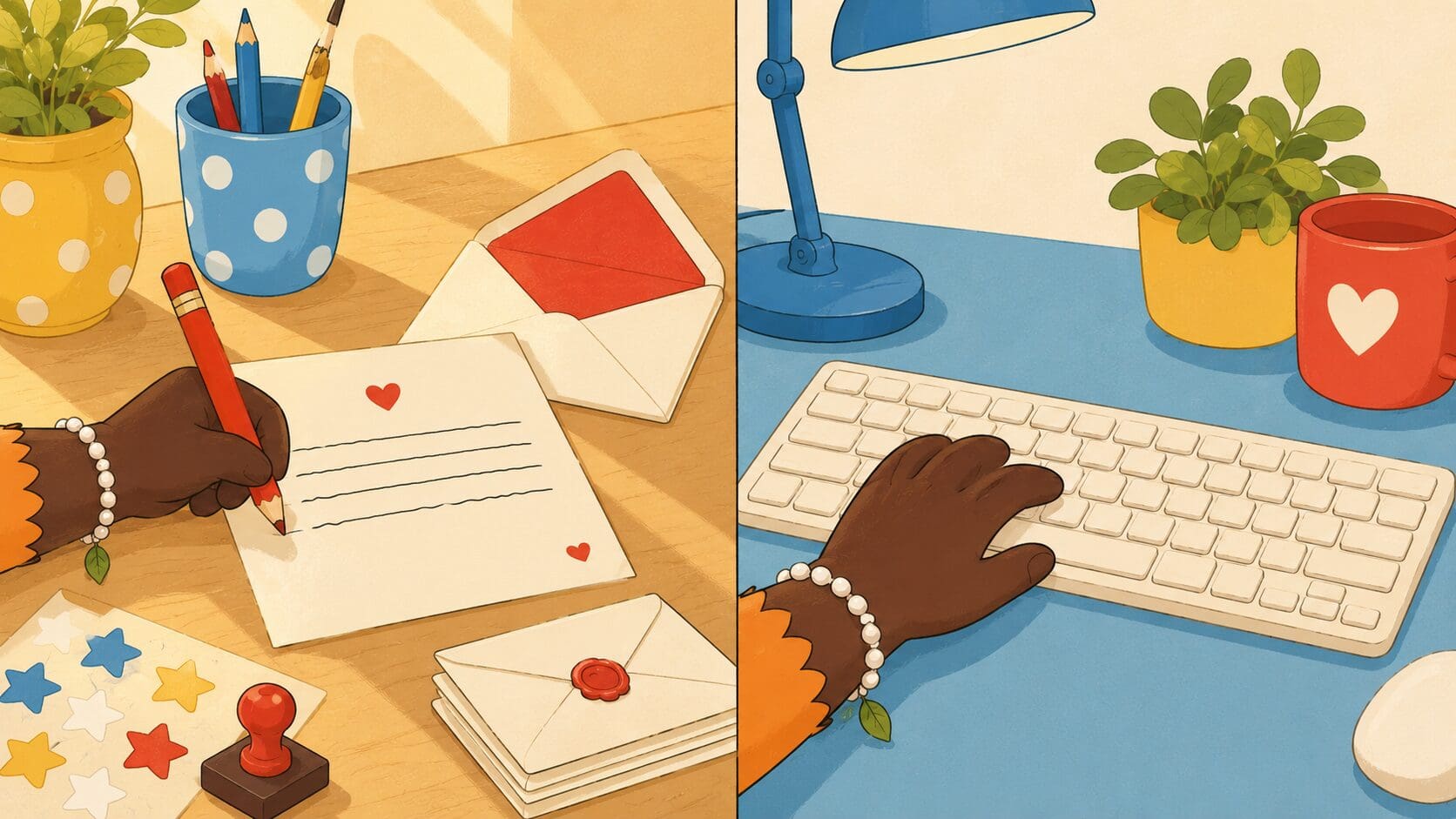
Handwriting and typing are not the same activity. They look similar from the outside — kid, surface, words appearing somewhere — but what’s happening in the brain during each one is genuinely, measurably different. And the difference matters more than most people realize.
This is not a case against keyboards. Keyboards are useful and your kid will need to type. But if you’ve been wondering whether the handwriting practice actually matters — whether the pen pal letters and the paper journals and the thank you notes are worth the effort — the answer is yes. Here’s why.
What happens in the brain when a child writes by hand.
When a child writes by hand three things happen simultaneously that don’t happen when they type:
They form the letter. They say the letter. They read the letter back.
That triple engagement — motor, auditory, visual — activates more of the brain at once than any other single learning activity. The physical act of forming a letter by hand fires up the motor cortex, the visual cortex, and the language centers all at the same time. Typing fires up significantly less of all three.
A landmark 2012 study by Karin James at Indiana University put this directly to the test. Children who had not yet learned to read or write were shown a letter and then asked to either trace it, draw it freehand, or type it. When they were put in an MRI scanner afterward and shown the same letter again, the children who had drawn it freehand showed activation in the same neural circuits used by adult readers — circuits that the tracers and typers did not activate.
In other words: drawing letters by hand primes the brain for reading in a way that typing simply does not.
For older kids who are already reading the finding shifts slightly but the principle holds. A 2014 study by Pam Mueller and Daniel Oppenheimer — published in Psychological Science and widely cited since — found that college students who took notes by hand retained information significantly better than students who typed the same notes. The reason: laptop note-takers transcribed more but processed less. Handwriters had to be selective, which forced them to actually think about what they were writing rather than just capturing it.
Slower, in this case, is better. The friction is the feature.
What handwriting does for young writers specifically.
For kids who are still developing as writers — which is most kids under twelve — the benefits of handwriting go beyond brain activation.
It slows down the thinking.
When a child types, the physical barrier between thought and output is almost zero. Words appear as fast as they can be produced. That sounds like an advantage. For developing writers it often isn’t — because the thinking hasn’t caught up to the typing yet and what comes out is often a first draft of a first draft.
Handwriting creates just enough friction to make a child think before they write. Not so much that they give up. Just enough that the words on the page are more considered than they would have been otherwise.
It builds reading fluency.
This one surprises people. The connection between handwriting and reading is well-established in the research but underappreciated in practice. When children learn to form letters by hand they build a neural map of each letter’s shape that helps them recognize it faster and more accurately when reading. Kids who write by hand tend to read more fluently than kids who don’t — not because writing and reading are the same skill but because they share underlying neural architecture.
It develops fine motor skills that transfer.
The grip, the pressure, the control required to write legibly — these are not just writing skills. They’re fine motor skills that transfer to a wide range of other activities and that have a developmental window. Kids who don’t get enough handwriting practice in early childhood often struggle to build the fine motor control they need later, not just for writing but for drawing, building, and other precise physical tasks.
It supports spelling.
Typing has autocorrect. Handwriting does not. Kids who write by hand are required to actually know how words are spelled — or to notice when they don’t. Research consistently shows that handwriting practice is associated with stronger spelling outcomes than typing practice. The physical act of forming a word letter by letter encodes it more deeply than selecting it from a dropdown or having it silently corrected.
What typing does well — and where it falls short.
To be fair: typing has real advantages. It’s faster. It’s more legible for kids with certain motor challenges. It’s the format most adult writing actually takes. And for kids who struggle with the physical act of handwriting — due to dysgraphia, motor delays, or other challenges — typing can be genuinely liberating.
The problem is not typing. The problem is the assumption that typing and handwriting are interchangeable — that one can fully substitute for the other with no meaningful difference in outcome.
The research says they can’t.
A 2023 study published in Frontiers in Psychology found that students who wrote by hand showed significantly stronger retention and comprehension than students who typed the same material. The researchers used EEG to measure brain activity during both tasks and found that handwriting produced more complex and interconnected neural patterns — the kind associated with deeper learning and longer-term memory.
Typing produced faster output. Handwriting produced better learning.
For a kid who is still building their brain — still laying the neural infrastructure they’ll use for the rest of their life — that distinction matters.
What this means practically.
You don’t have to choose between handwriting and typing. Most kids will need both and there’s room for both. But if you’re wondering where to prioritize handwriting practice — where it’s worth the extra time and the occasional resistance — here’s where it pays off most:
Early literacy (ages 3-7). This is the highest-leverage window. Handwriting practice during early literacy development has an outsized effect on reading fluency, letter recognition, and spelling. Don’t skip it in favor of a keyboard during these years.
Writing for meaning (any age). When your kid is writing something that matters — a story, a letter, a journal entry — paper is better. The slower pace produces more thoughtful output. The physical permanence makes it feel more real.
Learning new content (school age and up). Notes taken by hand are retained better than notes typed. If your kid is trying to actually learn something — not just capture it — a notebook beats a laptop.
Letters to their pen pal. Obviously.
The pen pal angle.
A pen pal letter is one of the few contexts where a child writes by hand for a real audience about things they actually care about with no grade attached.
That combination — real audience, genuine stakes, no rubric — produces some of the best handwriting practice available because it doesn’t feel like practice. It feels like writing to a friend. The motivation is intrinsic. The effort is real. The result goes in an envelope and travels across the country to someone who is going to read it carefully.
That’s a different experience from a handwriting worksheet. Neurologically and emotionally it’s a different experience. And it’s one that produces the kind of deep, motivated, meaningful writing practice that actually moves the needle.
The research, in plain language.
- Kids who write by hand activate more of their brain than kids who type the same content.
- Handwriting is associated with stronger reading fluency, better spelling, and improved memory retention.
- The physical formation of letters primes the brain for reading in a way that typing does not replicate.
- Notes taken by hand are remembered better than notes typed — because the slower pace forces more processing.
- The benefits are largest during early childhood but persist across the lifespan.
- Typing has real advantages and a place in every child’s education — but it is not a substitute for handwriting.
Further reading:
- Karin James, Indiana University (2012) — “The Effects of Handwriting Experience on Functional Brain Development in Pre-Literate Children”
- Mueller and Oppenheimer (2014) — “The Pen Is Mightier Than the Keyboard”
- Frontiers in Psychology (2023) — “Handwriting Versus Typewriting: Effect on Word Recall, Sentence Recall and Affective Judgments”
- Vanderbilt University Peabody College
- International Dyslexia Association
Related posts:
- What Getting Real Mail as a Kid Actually Did to Your Brain →
- Why Real Mail Hits Different (And It’s Not Just Nostalgia) →
- How to Start a Pen Pal Friendship for Your Kid (The Right Way) →
- 7 Ways to Help Your Reluctant Writer Fall in Love with Letters →
MailDay gives kids a real reason to write by hand every month — to a real person, on real paper, through the actual mail.
The research says it matters. The mailbox makes it worth it.
Join MailDay →